Paul Thompson
Strategic Adviser
I help Leadership Teams in regulated or politically exposed organisations
turn political and regulatory uncertainty into clear decisions and practical action.
I also train public affairs teams on how to deliver an impactful public affairs function.
Political Risk Clarity Sprint
30 days to turn political and policy uncertainty into a clear public affairs strategy.Political and regulatory change rarely arrives as one surprise event.It builds through drivers like policy uncertainty, shifting government priorities, regulatory pressure, stakeholder noise, media attention, funding risk, reputational exposure, and internal uncertainty.I help CEOs and executive management teams in regulated or politically exposed organisations make sense of political and regulatory change before it becomes a major problem or an internal crisis.Using the Political Risk Clarity Sprint, I help your leadership team identify what is changing, why it matters, where the real risks sit, what decisions need to be made, and what to do next.
The problem
Political uncertainty becomes a leadership problem when an organisation doesn't know what decisions to make, even if it has access to lots of information and commentary.Most organisations do not suffer from a lack of information.They have updates. Briefings. Stakeholder maps. Policy trackers. Internal meetings. External commentary.The problem is often that this information is not turned into shared interpretation and practical actions to align and make decisions at the right time.• Public Affairs and Communications may understand the external environment and reputational risk.
• Strategy may understand the material commercial implications.
• The Executive Team may see pieces of the picture, but not always the whole puzzle.That is when organisations become reactive.They wait too long.They over-focus on the wrong signals.They treat political risk as one team’s problem.They struggle to decide what to say, who to engage, and what to do next.
The problem is rarely a lack of information.It is a lack of clarity about what the information means and what an organisation should do with it.
Who is this for
The Political Risk Clarity Sprint is for CEOs, executive management teams, board members, and senior leaders in regulated or politically exposed organisations.It is especially relevant if your organisation is:
• Facing political or regulatory uncertainty
• Preparing for a policy, funding, planning, regulatory, or reputational decision
• Trying to understand what a change in government, policy, or regulation means for your strategy
• Dealing with stakeholder pressure or public scrutiny
• Struggling to align leadership around political risk
• Receiving plenty of external information but lacking clear decisions
• Relying heavily on one person or one team to interpret the external environment
What you will have by the endBy the end of the sprint, your leadership team will have clearer answers to five questions:
1. What is changing?
2. Why does it matter to us?
3. What risks and opportunities should we prioritise?
4. What decisions do we need to make?
5. What should we do next?
You will leave with:• A clearer view of the political and regulatory risks that matter
• A shared leadership understanding of the issue
• Clearer decision points
• Stakeholder engagement priorities
• Communications considerations
• A practical action plan
• More confidence in what to do before the situation escalatesThe aim is simple:Move from reacting to political and regulatory change to seeing it clearly, deciding confidently, and acting before the issue becomes harder to manage.
The process
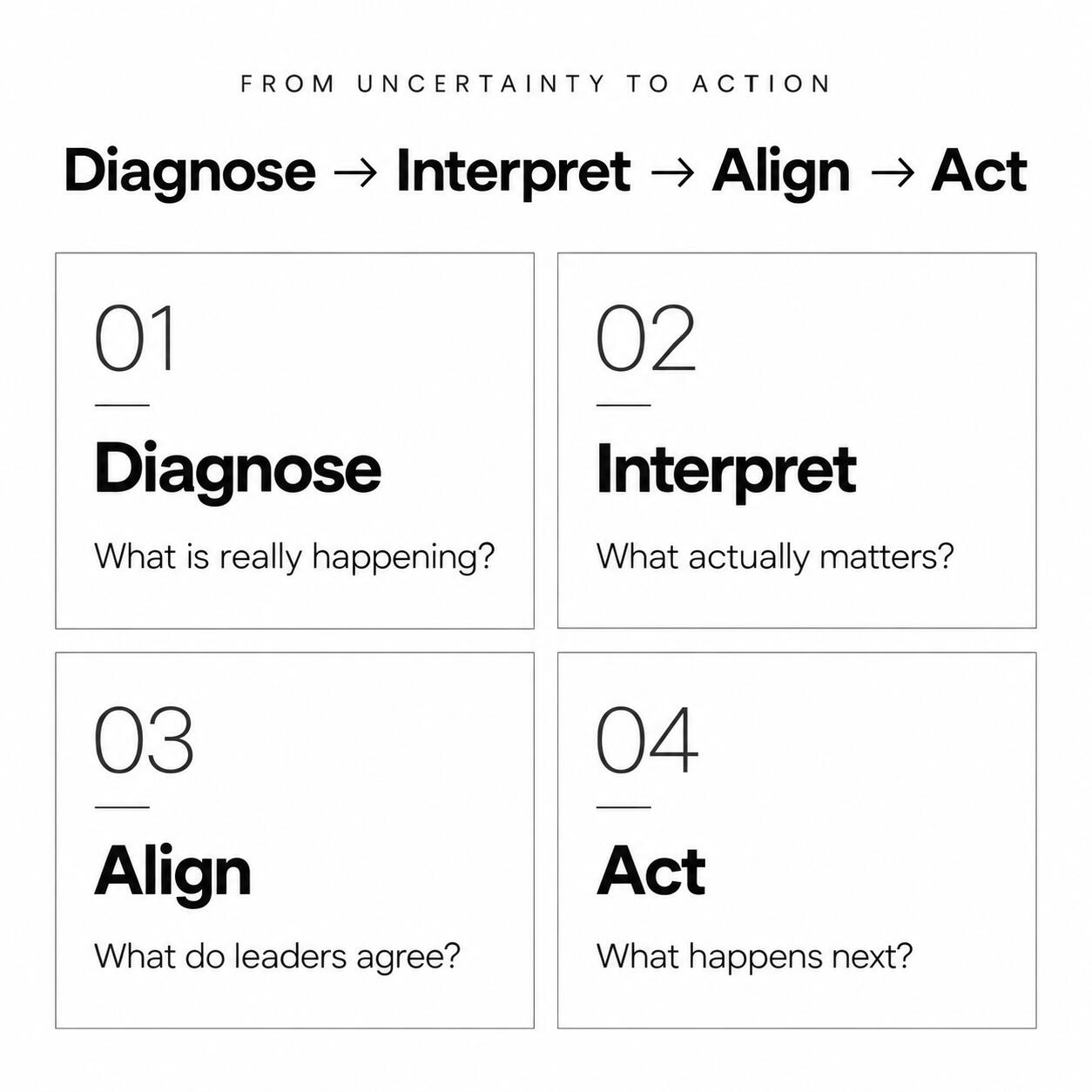
Week 1: DiagnoseClarify the issues, the context, and the decisions at stake.This may include:• An initial leadership briefing
• Review of relevant documents, plans, policy issues, stakeholder context, or current concerns
• Identification of political, regulatory, reputational, and strategic exposureWeek 2: InterpretSeparate noise from material risk.This stage identifies:• The risks that could affect strategy, reputation, operations, investment, or stakeholder confidence
• The assumptions your team may need to test
• The decisions that cannot be avoidedWeek 3: AlignBuild a shared understanding across the leadership team.• A focused executive workshop or advisory session to test the analysis
• Clarify choices
• Agree on priorities and align.Week 4: ActWe turn the analysis into practical next steps.You receive a clear action plan covering:• Priority political and regulatory risks
• Recommended leadership decisions
• Stakeholder engagement priorities
• Communications considerations
• Internal alignment needs
• Immediate next actionsWhat is includedThe sprint can be shaped around your organisation’s needs, but typically includes:
• Initial diagnostic conversation
• Leadership briefing call
• Review of relevant context, documents, policies, plans, or current concerns
• Political and regulatory risk map
• Identification of key strategic, reputational, and stakeholder implications
• Executive management team workshop or advisory session
• Practical engagement and communications recommendations
• Written action plan with priorities, decisions, and next steps
• Optional follow-up advisory session
What this is notThis is not:• A lobbying campaign
• Legal or regulatory advice
• Outsourced public affairs
• Generic political commentary
• A promise to secure a specific government, policy, funding, planning, or regulatory outcomePolitics cannot be controlled.But your interpretation, decisions, positioning, engagement and readiness can be improved.
Why work with me
I have spent 25 years advising chief executives and senior leaders across politically exposed and regulated sectors, including energy, transport, housing, and the creative industries:➡️ VPI|National Grid|Low Carbon Contracts Company|BVRLA|Design Council|UK Power Networks|National Audit Office|Ofcom|Arts Council England|IPSA|Audit Commission|IPPR|Policy Network|UK Parliament| Fleishman Hillard|Field Consulting|Greenhouse PR|GK Strategy|Public Affairs Experts|Community Housing CymruI have seen that the organisations that navigate uncertainty best are not always the biggest, smartest, or best resourced.They are the ones that:• Interpret the external environment clearly
• Make decisions before pressure peaks
• Engage with discipline
• Communicate with confidence
• Build political awareness beyond one team or functionThat is what the Political Risk Clarity Sprint is designed to help your leadership team do.
Why now
Political and regulatory risk is easiest to manage before it becomes urgent.Once an issue is public, live, or reputationally sensitive, your options narrow.This sprint is especially useful when your organisation is:• Preparing for political or regulatory change
• Facing a live policy or stakeholder issue
• Entering a new strategic planning cycle
• Dealing with public scrutiny
• Responding to a change in government priorities
• Trying to align leadership before a major decision
• Unsure whether an external issue is noise or material riskThe cost of waiting is not just being surprised.It is making slower, weaker decisions when the stakes are higher.
How we start working together
Before deciding on a project:1. We begin with a focused diagnostic conversation.In that session, we clarify:• What political or regulatory issue you are facing
• Why it matters now
• Who needs to be involved
• What decisions are at stake2. Decide if the Political Risk Clarity Sprint is the right fitIf it is not the right fit, I will say so.3. Begin the 30 day Sprint.Agree any changes to the scope and move forward into the execution phase.The clarity checkpointBefore final recommendations are delivered, we hold a decision-readiness checkpoint.This is where we test whether the priority risks, choices, and next actions are clear.If they are not, we sharpen the diagnosis before moving to the final action plan.The aim is to reduce vague advice and loose recommendations.You should leave the sprint with clarity that your leadership team can actually use.After the sprintSome organisations use the sprint as a standalone piece of work.Others continue with advisory support, leadership training, workshops, or coaching for public affairs and corporate affairs leaders.
Follow-on support can include:• Strategic counsel for CEOs and senior leaders
• Political awareness training for leadership teams
• Public affairs and strategic influence workshops
• Coaching for public affairs leaders who need more senior-level impact
• Speaking at conferences, away days, and senior leadership events
About

I have spent 25 years advising chief executives and senior leaders across politically exposed and regulated sectors, including energy, transport, housing, and the creative industries.I have seen that the organisations that navigate uncertainty best are not always the biggest, smartest, or best resourced.They are the ones that:•Interpret the external environment clearly and put lots of effort into doing this at the right time
•Understand the range of the decisions they need to make or options they have before pressure peaks
• Build political awareness beyond one team or functionThese are some of the organisations
I've worked with or provided services to and made a positive difference to over the years.➡️ VPI|National Grid|Low Carbon Contracts Company|BVRLA|Design Council|UK Power Networks|National Audit Office|Ofcom|Arts Council England|IPSA|Audit Commission|IPPR|Policy Network|UK Parliament| Fleishman Hillard|Field Consulting|Greenhouse PR|GK Strategy|Public Affairs Experts|Community Housing CymruWHAT SOME OTHERS SAY ABOUT ME➡️ Paul is a rare and immensely talented chap who seamlessly develops strategic thinking using his encyclopedic political knowledge to secure outstanding and impressive results. Paul produces extremely high-quality results and uses his strengths to collaborate with and build new partnerships. Absolutely pleasure to work with and I’ve learnt such a great deal from him! Jay Parmer, Chief Executive, The Joint Industry Board for the Electrical Contracting Industry➡️ I have managed Paul and also commissioned him as a freelancer. My experience of Paul is that he always tries to deliver his best and consistently delivers to a very high standard. He can confidently work through multiple high-profile political issues at the same time and has delivered great outcomes for me. Paul combines a great understanding of politics and policy, and can translate this into good advice that helps companies chart a way through any problems. If you want a government affairs professional who will bring creativity and discipline to a project, I would definitely recommend him. Janine Freeman, Net Zero Transition Leader➡️ Paul is the ideal person to step into an interim leadership role, particularly one that focuses on policy or public affairs. At Community Housing Cymru, I was very impressed by how quickly he got up to speed with core strategic challenges and the deliverables required. Similarly, he swiftly built an understanding of the needs of the social housing sector and the particular political considerations within Wales. Not only did he gain the trust of the team at CHC, member organisations, MSs and officials, he also led work which achieved significant policy wins. Laura Courtney, Head of Policy and External Affairs at Community Housing Cymru.➡️ Paul has the ability to offer sharp insight that helps make better public affairs strategies and improves the quality of engagement organisations carry out. He's able to think about the long-term consequences of public affairs activity and also provide what is needed in the immediate. Having worked closely with Paul, I can confidently say that he's grounded in his thinking, executes and delivers and challenges himself to find the best solution for organisations. I have found his insight and thinking really helpful at different times we've worked together. Iwan Hughes, Director of Regulation and Grid Services, VPI
Contact
Email: [email protected]Phone: +44 (0) 7582841242
AI for Public Affairs Teams
Use AI to work faster, think better and improve advice, whilst still retaining judgement.
AI is already changing how public affairs, policy and communications teams work.The challenge is not just understanding AI tools, but knowing where AI creates opportunities and risks, and where human judgement must remain in control.AI can help teams move faster, but speed is not the main prize.Used well, AI can help teams process information more effectively, test assumptions, improve advice, strengthen briefings, challenge weak thinking and free up more time for strategy, judgement and influence.This practical one-day course is designed for public affairs, policy, government relations and communications teams that want to use AI confidently, safely and effectively in their day-to-day work.The course moves beyond basic prompting. Participants learn how to apply AI to real public affairs workflows, including political monitoring, policy analysis, stakeholder intelligence, executive briefing, ministerial letters, message development, strategic challenge and responsible use.The focus is practical throughout: how to get better outputs, how to give AI the right context, how to choose the right tool for the task, and how to keep human judgement in control.
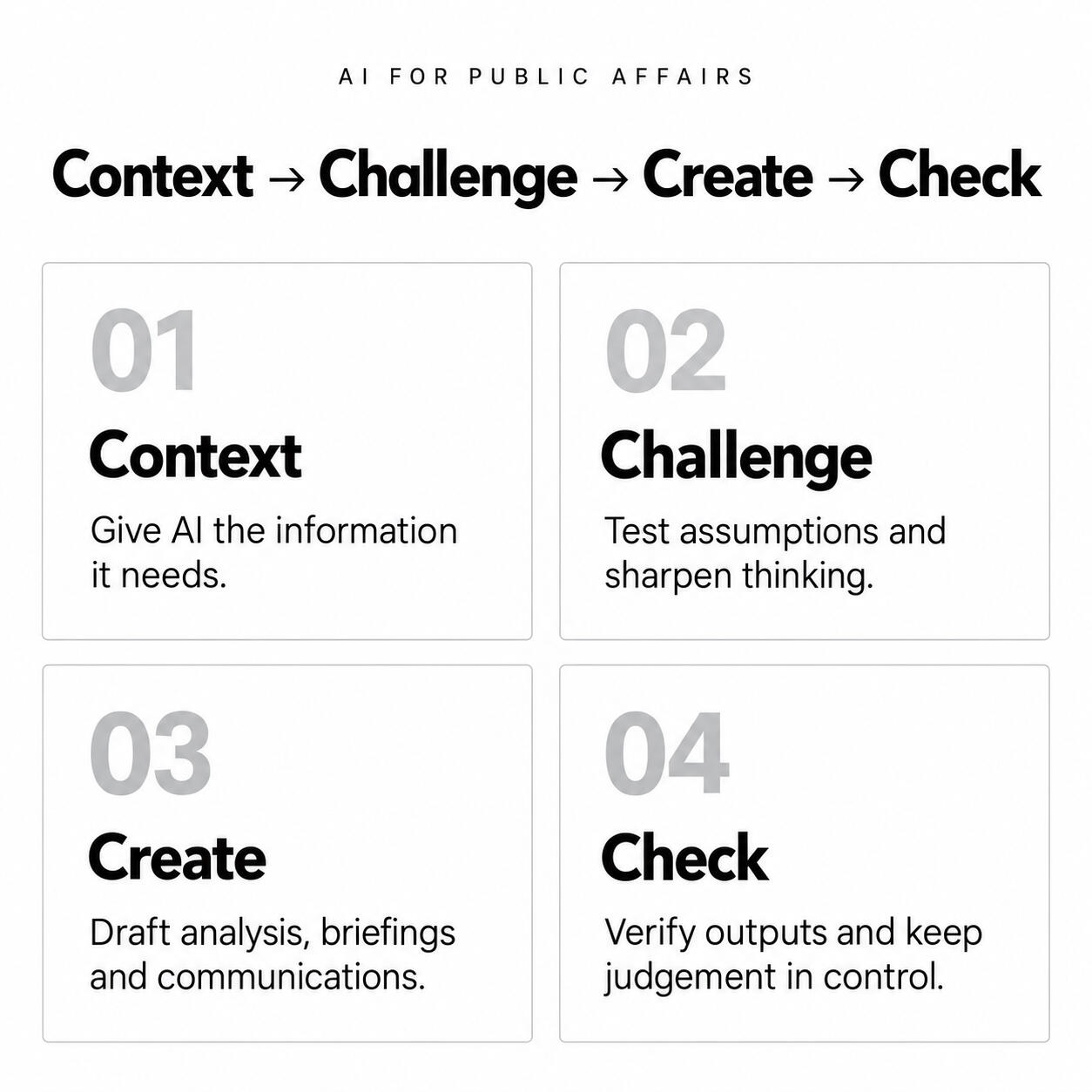
Why this course mattersPublic affairs teams are dealing with more information, faster political cycles, greater uncertainty and rising expectations from senior leaders.AI can help, but only if teams know how to use it well.Used badly, AI can produce generic summaries, weak analysis, inaccurate claims or communications that miss the political context.Used well, it can help teams work more efficiently, think more clearly and improve the quality of advice they provide to senior colleagues.This course helps participants understand not just what AI can do, but how to apply it sensibly in public affairs, policy and stakeholder work.
The challenge isn't just understanding AI tools but where it creates opportunities, risks and where your judgement must remain in control.
Who is it for?This course is designed for:• Public affairs and government relations teams
• Policy teams
• Communications professionals working on policy, stakeholder or regulatory issues
• In-house teams working in regulated, politically exposed or complex stakeholder environments
• Teams that want to use tools such as Microsoft Copilot, ChatGPT, Claude or Perplexity more effectively and responsiblyWhat participants will learnBy the end of the day, participants will understand:
• What AI can and cannot do in a public affairs context
• How to improve AI outputs by providing better context
• How to use AI for political monitoring, policy analysis, briefings and stakeholder intelligence
• How to use AI as a thinking partner to challenge assumptions and surface blind spots
• How to improve messages, ministerial letters and campaign narratives
• How to use AI safely, including practical safeguards around confidentiality, verification and human review
• How to build one practical AI workflow to test with the team after the course
What makes the course different?Many AI courses focus on prompts, tools or productivity.
This is not just an AI course about tools with some public affairs examples.It is a course about using AI well and integrating it into your public affairs day job.
Participants will learn how AI can support the work that matters most in public affairs and policy: understanding what is changing, identifying what matters, advising senior leaders, influencing stakeholders, testing arguments and communicating clearly.
Course formatThis is a one-day interactive workshop.It combines clear explanations, live demonstrations, practical exercises and group discussions. The course can be tailored to the tools your organisation allows, including Microsoft Copilot, ChatGPT, Claude, Perplexity or approved internal AI systems.The session can also be adapted depending on the audience’s level of AI confidence, sector, policy focus and internal governance requirements.Other details• Delivery: Face-to-face or online
• Participants: Up to six participants.
• Alternative delivery: Can be delivered as two half-day sessions.
• Language: English.
• Bespoke: Content can be adapted to your organisation, sector and political context.
• Pre-course preparation: Short participant questionnaire may be used.
• Evaluation: Post-course feedback collected.Price: start at £950 for one participant and £3,250 for up to six participants.To discuss a tailored version for your public affairs, policy or communications team, get in touch to arrange a conversation or request the detailed course agenda.
Introduction to Public Affairs
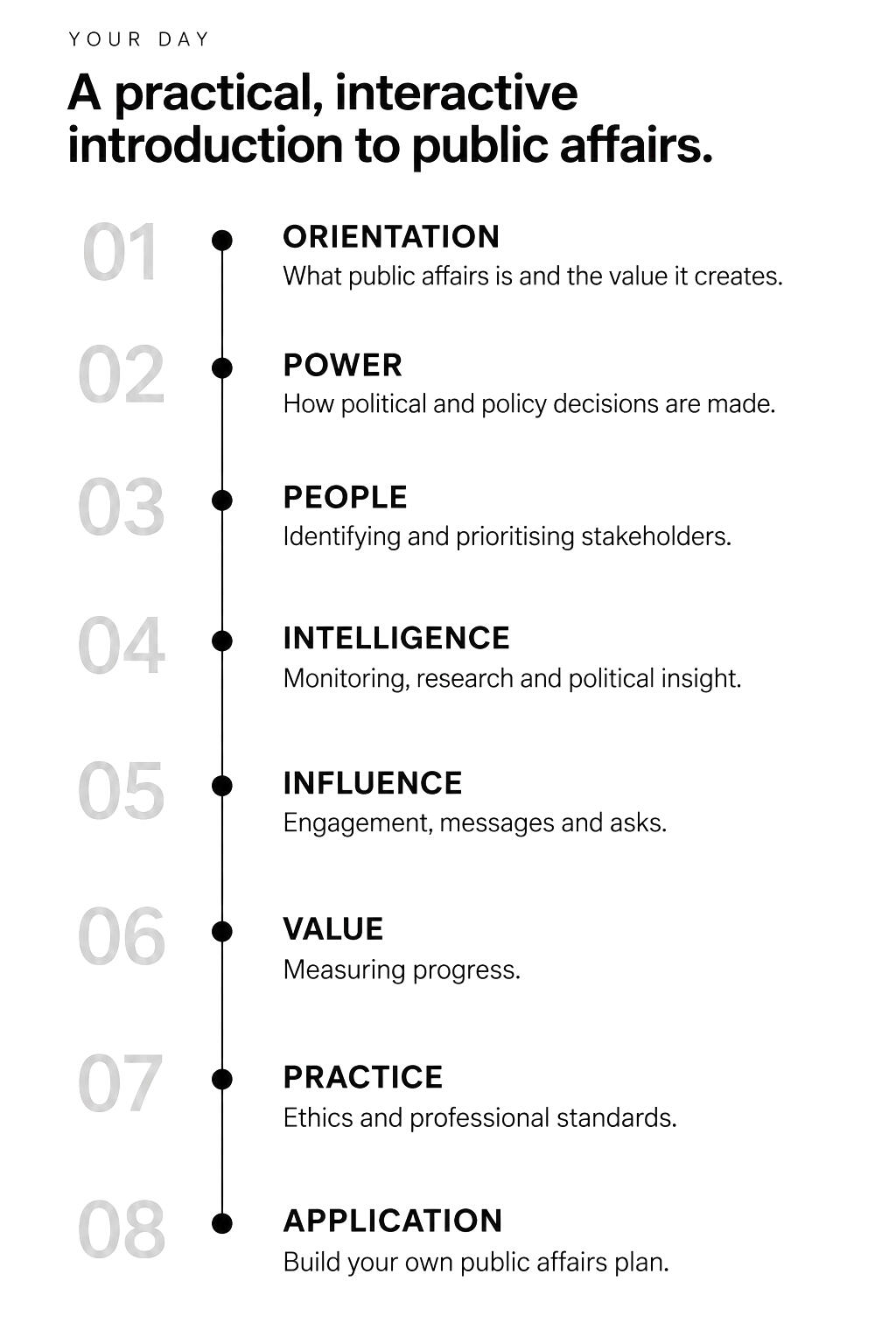
By the end of the day, your understanding of how public affairs can achieve major organisational objectives will improve. Specifically, you will leave with:
1. A clear understanding of what public affairs is and its value.
2. Greater confidence in understanding how political and policy decisions are made.
3. Greater confidence in identifying and prioritising the stakeholders who matter most.
4. A better understanding of how to monitor political and policy developments and turn information into useful advice.
5. A better understanding of the most effective engagement methods used by public affairs professionals.
6. A practical framework for planning public affairs activity and measuring whether it is making progress.
7. Greater confidence in operating professionally, ethically and effectively as a public affairs practitioner.
It was hugely beneficial to receive public affairs training from Paul and it enabled my team to think about how we can create a more robust internal public affairs strategy going forward. Delivered in a calm and approachable manner, Paul offered space for frequent discussions and made the training an engageable delight.Bryony Haynes, Community Housing CymruPaul’s public affairs training was inspiring and informative for the whole Policy and External Affairs team at Community Housing Cymru. It was highly beneficial for those who were new to public affairs, and also for those with many years of experience. I would highly recommend Paul as a trainer in the fields of public affairs and policy influencing.Laura Courtney, Head of Policy and External Affairs, Community Housing Cymru
What we will focus on
1. IntroductionWe will begin by discussing participants’ experience of public affairs, what they want to gain from the course and the political or policy issues that matter most to their organisation.
2. Understanding public affairsWe will explore:• What public affairs is.
• Why organisations invest in public affairs.
• The difference between public affairs, public relations, policy, communications and campaigning.
• How public affairs supports organisational objectives.
• How public affairs works with communications, policy, legal, commercial, operational and leadership teams.
• The difference between political access, visibility, relationships and influence.
• What effective public affairs professionals contribute to an organisation.
What is the value of this section?• You will have a clearer understanding of what public affairs can realistically achieve.
• You will be better able to explain the value of public affairs to colleagues and senior leaders.
• You will understand how public affairs should connect external political engagement with internal organisational priorities.
3. How political and policy decisions are madeWe will explore:• How political and policy decisions move from ideas to implementation.
• The roles of ministers, civil servants, special advisers, parliamentarians and political parties.
• The role of the UK Parliament.
• The role of devolved governments and legislatures.
• How regulators, local government and other public bodies shape decisions.
• The role of external organisations such as businesses, trade bodies and campaign groups.
• Formal and informal routes of influence.
• Why timing matters in public affairs.
• How to identify when a decision can still be influenced.
What is the value of this section?• You will better understand where political and policy power sits.
• You will be able to identify who influences a decision, not just who is formally responsible.
• You will be better placed to engage at the right stage, with the right people and for the right purpose.
4. Identifying and prioritising stakeholdersWe will explore:• What makes someone a priority stakeholder.
• The difference between decision-makers, influencers, advisers, allies, blockers and external validators.
• How stakeholder importance can change during a campaign or policy process.
• How to distinguish between access and influence.
• How to prioritise limited time and resources.
What is the value of this section?• You will have a clearer understanding of who matters and why.
• You will be better able to focus engagement on stakeholders who can affect outcomes.
• You will reduce time spent on activity that creates visibility but little influence.
5. Political intelligence, monitoring and researchWe will explore:• The main sources of political and policy information.
• Parliamentary, government, regulatory and political party sources.
• Media, think tanks, trade bodies and stakeholder intelligence.
• How to distinguish useful intelligence from general noise.
• How to assess relevance, reliability and urgency.
• How to organise political monitoring.
• How to identify emerging risks and opportunities.
• How to turn information into useful internal advice.
What is the value of this section?• You will understand how to stay informed without becoming overwhelmed.
• You will be better able to identify what matters for your organisation.
• You will gain confidence in turning political information into relevant advice for colleagues and senior leaders.
6. Public affairs engagement, messages and stakeholder asksWe will explore:• The main methods of public affairs engagement.
• How to choose the right approach for the objective and stakeholder.
• How to prepare for stakeholder engagement.
• The difference between narrative, message, evidence and ask.
• How to make engagement relevant to stakeholders.
• How to make clear, credible and realistic requests.
• Why messages must be adapted for different audiences.
What is the value of this section?• You will better understand how to select appropriate engagement methods.
• You will be more confident in explaining what you want stakeholders to understand or do.
• You will be less likely to treat meetings as an end in themselves.
7. Measuring progress and demonstrating valueWe will explore:• Why counting meetings is not enough.
• The difference between activities, outputs, outcomes and impact.
• How to establish a baseline.
• How to measure changes in access, relationships and influence.
• How to track progress through a policy process.
• How to demonstrate value over time.
What is the value of this section?• You will understand how to measure more than activity.
• You will be able to identify practical signs of progress.
• You will be better equipped to explain the contribution of public affairs internally.
8. Ethics and professional practiceWe will explore:• Transparency, accuracy and honesty.
• Appropriate engagement with stakeholders.
• Confidentiality and responsible use of information.
• Conflicts of interest.
• Political neutrality and organisational reputation.
• Common ethical risks.
• Responding to pressure and difficult situations.
What is the value of this section?• You will have a stronger understanding of professional responsibilities.
• You will be better able to protect your reputation and your organisation’s.
• You will have a framework for handling ethical challenges.
9. Applying the learning and next stepsWe will bring the course together by developing a simple public affairs plan for a real or fictional issue, including:• Objective.
• Policy or political outcome.
• Decision-making route.
• Priority stakeholders.
• Core messages and asks.
• Initial engagement activity.
• Intelligence sources.
• Measures of progress.
What is the value of this section?• You will leave with a practical framework you can use immediately.
• You will understand how the different parts of public affairs fit together.
• You will have a clearer sense of next steps within your organisation.
Other details• Delivery: Face-to-face or online (Zoom, Google Meet or Microsoft Teams).
• Participants: Up to 6 participants.
• Alternative delivery: Can be delivered as two half-day sessions.
• Language: English.
• Tailoring: Content can be adapted to your organisation, sector and political context.
• Pre-course preparation: Short participant questionnaire may be used.
Investment:• Corporate organisations: from £995 for one participant.• Team workshops: up to six participants: £2,095• Early Stage Business and Small Charity Rate: from £695 for one participant.• Team workshops: up to six participants: £1,695
Some more about meI have worked for 25 years in public affairs, government relations, political strategy and policy influencing across energy, automotive, creative industries and local government sectors.I have worked with FTSE-listed companies, Parliament, regulators, public bodies, trade associations, think tanks, consultancies and agencies.Organisations include:➡️ VPI | National Grid | BVRLA | Design Council | UK Power Networks | National Audit Office | Ofcom | Arts Council England | IPSA | Audit Commission | IPPR | Policy Network | UK Parliament | FleishmanHillard | Field Consulting | Greenhouse Communications | GK Strategy | Public Affairs Experts | Community Housing CymruMy expertise includes:• Advising senior leaders on political engagement.
• Designing public affairs strategies and campaigns.
• Supporting organisations to engage effectively with decision-makers.
• Translating political developments into strategic advice.
• Building stakeholder relationships and coalitions.
• Managing and developing public affairs teams.
• Training and coaching professionals.
• Facilitating strategic discussions and planning.
Want to explore how I can help?The first step is a short compatibility call.We will discuss:• Your participants and their needs.
• Your political and policy context.
• Your desired outcomes.
• Any organisational priorities to reflect in the training.
• Whether I am the right fit to support your team.
Public Affairs Strategy Workshop
What you will gain1. A clear foundation for a focused public affairs strategy linked to your organisation’s priorities.2. Greater clarity about what your organisation wants to change, why it matters and what political or policy outcomes are required.3. A practical assessment of the political and policy environment in which your strategy will operate.4. A better understanding of how relevant decisions are made and where influence can be applied.5. A prioritised approach to the stakeholders who matter most.6. The foundations of a clear narrative, supporting messages, evidence and stakeholder asks.7. A focused set of public affairs tactics and an initial 90-day delivery plan.8. Practical measures for assessing progress and demonstrating the value of public affairs.9. Greater clarity about ownership, resources and the internal support required to deliver the strategy.
What we will discuss and work on together1. Introduction and current positionWe will begin by agreeing the purpose of the workshop, the outcomes the organisation wants to achieve and the main political or policy issues the strategy needs to address.We will explore:• What the organisation needs public affairs to deliver.• What is currently working well.• What may be preventing greater influence.• How public affairs is understood across the organisation.• The internal support required to deliver an effective strategy.
What is the value of this section?• You will establish a shared understanding of the purpose of the strategy.• You will identify the organisational outcomes public affairs needs to support.• You will recognise internal strengths and barriers that may affect delivery.
2. Six strategic principlesWe will introduce six principles that will guide the workshop:1. Work out what you want to change and why.2. Give people a reason to pay attention.3. Define what you want others to understand, support or do.4. Build relationships with the people who can affect the outcome.5. Bring value to political and policy decision-makers.6. Secure the support and contribution of colleagues across the organisation.
What is the value of this section?• You will have a clear framework for testing objectives, stakeholder choices, messages and tactics.• You will be encouraged to focus on outcomes rather than activity.
3. Political and policy contextWe will assess the environment in which the strategy will operate.We will explore:• Government, legislative, regulatory and political priorities.• Important political and policy decisions and timelines.• External opportunities and constraints.• Stakeholder positions and areas of support or opposition.• Political risks, uncertainties and assumptions.
What is the value of this section?• Your strategy will be grounded in the political environment affecting your organisation.• You will identify important opportunities, constraints and uncertainties.• You will reduce the risk of building a strategy around weak or outdated assumptions.
4. Defining the future and agreeing strategic objectivesWe will clarify what the organisation wants to achieve and translate this into focused public affairs objectives.We will explore:• What the organisation wants to protect, change, prevent or create.• The political, policy or regulatory outcomes required.• Who needs to make a decision or change their position.• How the organisation wants to be perceived by important stakeholders.• What success should look like over the next 12 months and beyond.• What is ambitious but still realistic.
What is the value of this section?• You will move from broad ambitions to a focused set of strategic objectives.• You will be clearer about what needs to change, who needs to act and why it matters.• You will avoid producing a strategy that is mainly a list of activities.
5. Decision-making, influence and priority stakeholdersWe will examine how relevant decisions are made and identify the people and organisations that can affect the outcome.We will explore:• Where formal decision-making authority sits.• Who advises, influences, supports or blocks a decision.• The political stages, deadlines and opportunities that matter.• Stakeholder power, position, relevance and relationship strength.• Existing support, neutrality or opposition.• Gaps in access, trust, evidence and credibility.• How stakeholders should be targeted and prioritised.• Who should own important stakeholder relationships internally.
What is the value of this section?• You will understand how important political and policy decisions may be influenced.• You will identify who matters and why.• You will focus limited time and resources on stakeholders who can affect an outcome.• You will reduce activity that creates visibility but little strategic value.
6. Reviewing and confirming strategic choicesWe will review the work completed during the morning and confirm:• The most important political and policy opportunities.• The organisation’s priority strategic objectives.• The decision-making routes that matter.• The stakeholders who should receive the greatest attention.• The assumptions and risks that need to be monitored.
What is the value of this section?• You will consolidate the main strategic decisions made during the morning.• You will identify any areas that still require clarification.• You will create a clear foundation for developing messages, tactics and delivery plans.
7. Narrative, messages, evidence and stakeholder asksWe will develop the foundations of a clear and credible public affairs narrative.We will explore:• The wider story the organisation needs to communicate.• Why the issue should matter to political and policy audiences.• The organisation’s strongest messages.• The evidence and examples that support its position.• What the organisation wants stakeholders to understand, support or do.• How messages should be adapted for different audiences.• How to make stakeholder asks specific, realistic and actionable.
What is the value of this section?• You will have the foundations of a clear public affairs narrative.• You will be clearer about what you want stakeholders to understand or do.• You will be better prepared for political and policy engagement.• You will reduce the risk of inconsistent or unfocused communications.
8. Selecting tactics and creating a 90-day delivery planWe will identify the activities most likely to support each strategic objective and translate them into an initial plan.Potential tactics may include:• Direct stakeholder engagement.• Written briefings and submissions.• Parliamentary and government engagement.• Events and site visits.• Coalition-building and third-party advocacy.• Research and evidence.• Think tank and trade association activity.• Media and communications.We will assess potential tactics according to:• Strategic relevance.• Likely impact.• Effort and cost.• Timing.• Organisational credibility and capacity.• Political and reputational risk.• Likelihood of success.The initial 90-day plan will identify:• Priority actions.• Owners.• Deadlines.• Dependencies.• Stakeholder engagement.• Evidence and communications needs.• Risks.• Measures of progress.• Review points.
What is the value of this section?• You will identify a focused set of activities linked to your strategic objectives.• You will challenge existing activity and identify where effort may be wasted.• You will have a stronger basis for prioritising time and resources.• You will leave with an initial plan for moving the strategy into delivery.
9. Measurement and ownershipWe will consider how the strategy will be delivered and how progress will be assessed.We will explore:• The difference between activities, outputs, outcomes and impact.• How to establish a starting position.• How to track changes in access, relationships, sentiment and influence.• The skills, capacity and resources required.• Senior sponsorship and internal support.• Ownership of objectives and stakeholder relationships.• Who approves messages and positions.• How progress should be reported and reviewed.
What is the value of this section?• You will understand how to measure more than activity.• You will identify practical signs of progress.• You will be better able to demonstrate the value of public affairs internally.• You will establish clearer responsibility and accountability.
10. Decisions, next steps and closeWe will confirm:• The main strategic decisions made during the workshop.• Immediate actions.• Owners and deadlines.• Areas that require further information or internal agreement.• How progress will be reviewed.• What needs to happen after the workshop to complete and implement the strategy.
What is the value of this section?• You will leave with a shared understanding of the strategy’s direction.• Participants will be clear about their immediate responsibilities.• The organisation will have a basis for maintaining momentum after the workshop.
What you should have by the end of the workshopDepending on the organisation, preparation and available information, the workshop should produce the foundations of:1. A concise political and policy context assessment.2. A clear public affairs ambition.3. Three to five priority strategic objectives.4. A decision-making and influence map.5. A prioritised stakeholder map.6. The foundations of a central narrative.7. Supporting messages, evidence and stakeholder asks.8. A focused set of prioritised tactics.9. An initial 90-day delivery plan.10. Initial measures of progress.11. Agreed ownership and responsibilities.12. Clear next steps for completing and implementing the strategy.
Other details• Delivery: Face-to-face or online through Zoom, Google Meet or Microsoft Teams.• Participants: Up to six participants.• Duration: One day, from 9.00 to 17.00.• Alternative delivery: The workshop can be delivered as two half-day sessions.• Language: English.• Tailoring: The workshop will be adapted to your organisation, sector and political context.• Pre-workshop preparation: A discovery call, participant questionnaire.• Materials: Workshop materials and templates will be provided.• Follow-up support: Additional support can be agreed to help complete, review or implement the strategy.• Investment: Workshops are tailored to each organisation and typically range from £1,495 to £2,995, depending on the number of participants and level of preparation required.A reduced rate is available for eligible early stage businesses and small charities.Please get in contact to arrange a call to discuss your objectives.
Some more about meI have worked for 25 years in public affairs, government relations, political strategy and policy influencing across the energy, automotive, creative industries and local government sectors.I have worked with FTSE-listed companies, Parliament, regulators, public bodies, trade associations, think tanks, consultancies and agencies.Organisations include:➡️ VPI | National Grid | BVRLA | Design Council | UK Power Networks | National Audit Office | Ofcom | Arts Council England | IPSA | Audit Commission | IPPR | Policy Network | UK Parliament | FleishmanHillard | Field Consulting | Greenhouse Communications | GK Strategy | Public Affairs Experts | Community Housing CymruMy expertise includes:• Advising senior leaders on political engagement.• Designing public affairs strategies and campaigns.• Supporting organisations to engage effectively with political and policy decision-makers.• Translating political developments into strategic advice.• Developing stakeholder strategies, narratives and campaigns.• Supporting Executive and Board decision-making.• Building and developing public affairs teams.• Training, coaching and facilitating professionals and senior leaders.
Want to explore how I can helpThe first step is a short compatibility call.We will discuss:• Your organisation’s priorities and desired outcomes.• The political and policy issues that matter most.• The current position of your public affairs function.• The people who should participate.• The preparation and tailoring required.• Whether I am the right fit to support your team.
Public Affairs Leadership Programme
Public affairs leaders operate in demanding environments.They need to interpret political and regulatory developments, advise senior executives, influence colleagues across the organisation, lead teams, manage competing priorities and make decisions when the position is uncertain.Being an excellent public affairs practitioner does not automatically prepare someone for these responsibilities.
The Public Affairs Leadership Programme is a practical two-day development programme for public affairs managers, heads of public affairs, future public affairs leaders, corporate affairs directors and communications leads who want to strengthen their strategic judgement, organisational influence, people leadership and personal effectiveness.
At GK we know the mission critical importance of high-quality training and development of our team. Paul has worked with our senior next-generation public affairs leaders to help equip them through his unique and very practical training with the consulting, team and leadership skills needed for their future with us.Scott Dodsworth, Managing Director, GK Strategy
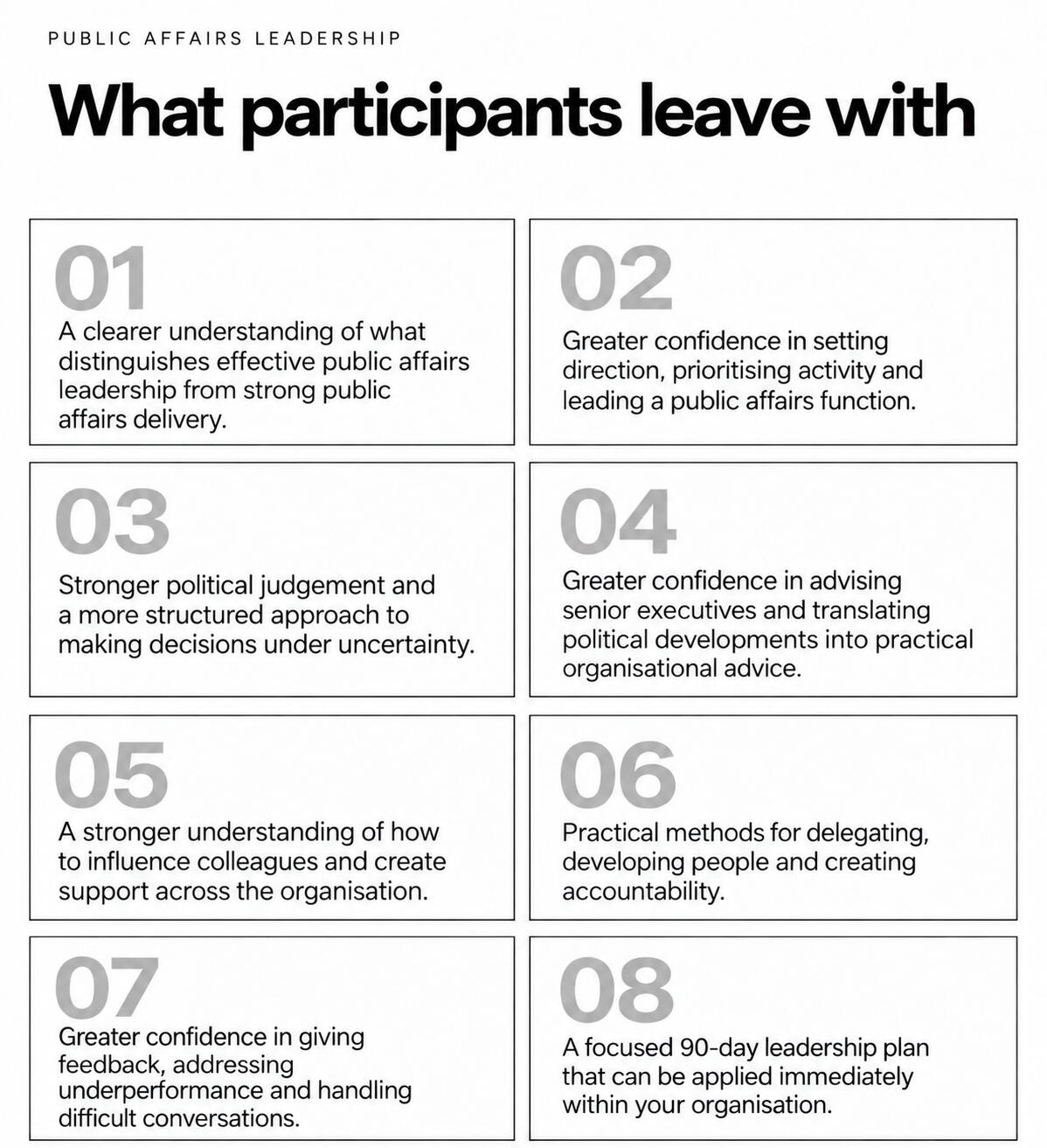
What you will gain
The programme gives participants a rare opportunity to step back from day-to-day delivery, reflect on how they lead and identify practical changes they can apply immediately.
“We worked with Paul over the course of two days as part of his public affairs leadership training. The course struck just the right balance between the theory and the practical, with the discussion-based format enabling us to look at issues in detail, as well as explore solutions together to address common challenges. Paul’s follow-up support, including helping us to develop long-term plans to support our own professional development, has been invaluable. We hope to work with Paul again and would not hesitate to recommend the course to others.”Public Affairs Team, GK Strategy
What we will discuss and work on together
The programme focuses on two critical questions for public affairs leaders. First, what to focus on to lead. Second, how to lead so others do well.
DAY ONE1. Stepping into leadership2. Strategy + political judgement3. Executive adviser4. Leading across the organisation5. High-performing functionDAY TWO6. Leading through others7. Feedback + difficult conversations8. Leading yourself under pressure9. Integrating how you lead.10. 90-day leadership plan
Day One: Leading the public affairs function
1. Stepping into public affairs leadership (9.00 to 10.00)
We will begin by discussing participants’ current responsibilities, leadership challenges and objectives for the programme.We will focus on:• The difference between delivering public affairs and leading it.
• How expectations change when someone becomes responsible for a team or function.
• Balancing strategy, executive advice, political engagement, delivery and people leadership.
• Identifying the leadership responsibilities that require the greatest attention.You will develop a clearer understanding of your role as a public affairs leader and the areas of leadership you need to strengthen.
2. Leading strategy and political judgement (10.00 to 11.30)
Public affairs leaders need to help their teams distinguish what matters from what is simply creating noise, then provide direction when the political or regulatory position is uncertain.We will focus on:• Turning organisational objectives into focused public affairs priorities.
• Testing assumptions about politics, policy, regulation and stakeholders.
• Making decisions when evidence is incomplete.
• Balancing immediate demands with longer-term strategic objectives.
• Developing political judgement across the team.You will strengthen your ability to set direction, prioritise activity and prevent the function from becoming overly reactive.
3. Becoming a credible executive adviser (11.45 to 13.15)
Senior leaders rarely need more political information. They need to understand what developments mean for the organisation, what choices are available and what action may be required.We will focus on:
• Turning political and regulatory information into clear organisational advice.
• Presenting implications, choices, trade-offs and recommendations.
• Communicating uncertainty without becoming vague or indecisive.
• Constructively challenging senior colleagues.
• Building credibility and trust as an adviser.You will become more confident translating political developments into focused advice that senior leaders can use.
4. Leading across the organisation (14.15 to 15.30)
Public affairs leaders depend on colleagues across the organisation, many of whom they do not manage directly.We will focus on:
• Influencing without formal authority.
• Working across policy, communications, legal, commercial, operational and strategy teams.
• Managing different internal priorities and perspectives.
• Building shared ownership of political and regulatory issues.
• Creating stronger internal alliances.You will improve your ability to build support, manage disagreement and prevent public affairs from operating in isolation.
5. Building a high-performing public affairs function (15.45 to 16.45)
We will consider the conditions public affairs leaders need to create for teams and functions to perform consistently well.We will focus on:
• Defining the purpose and contribution of the function.
• Setting clear priorities, standards and expectations.
• Creating accountability and ownership.
• Developing capability and political judgement.
• Measuring performance beyond meetings and activity.You will identify practical ways to strengthen team performance, accountability and professional development.
Day One reflection (16.45 to 17.00)
Participants will reflect on:
• What they need to lead more clearly.
• Where their function may lack direction or alignment.
• Which leadership responsibilities require more attention.
• What they want to explore further during Day Two.
Day Two: Exercising leadership through people and behaviour
6. Leading through others (9.00 to 10.30)
Moving into leadership requires a shift from personally delivering most of the work to creating results through other people.We will focus on:
• Delegating responsibility rather than simply allocating tasks.
• Setting clear expectations and outcomes.
• Giving people appropriate autonomy.
• Coaching others to develop their own judgement.
• Knowing when to intervene and when to step back.You will become more confident developing others, creating accountability and reducing the team’s dependence on you for every decision.
7. Feedback, underperformance and difficult conversations
(10.45 to 12.30)
Avoiding difficult conversations can weaken standards, confidence, accountability and team culture.We will focus on:• Giving clear and constructive feedback.
• Addressing underperformance early.
• Preparing for challenging conversations.
• Managing defensiveness, disagreement and conflict.
• Maintaining trust while being clear about expectations.Participants will consider realistic public affairs leadership situations and how they could respond more effectively.You will gain a practical structure for handling difficult conversations with greater clarity and confidence.
8. Leading yourself under pressure (13.30 to 15.00)
Public affairs leaders are often expected to remain calm, credible and decisive during political uncertainty, organisational pressure and reputational risk.We will focus on:
• Understanding how pressure affects leadership behaviour.
• Recognising patterns such as perfectionism, avoidance and people pleasing.
• Acting confidently without pretending to have all the answers.
• Combining compassion with clear expectations.
• Understanding how your behaviour affects team confidence and culture.You will develop greater awareness of how you lead under pressure and identify practical ways to respond more deliberately.
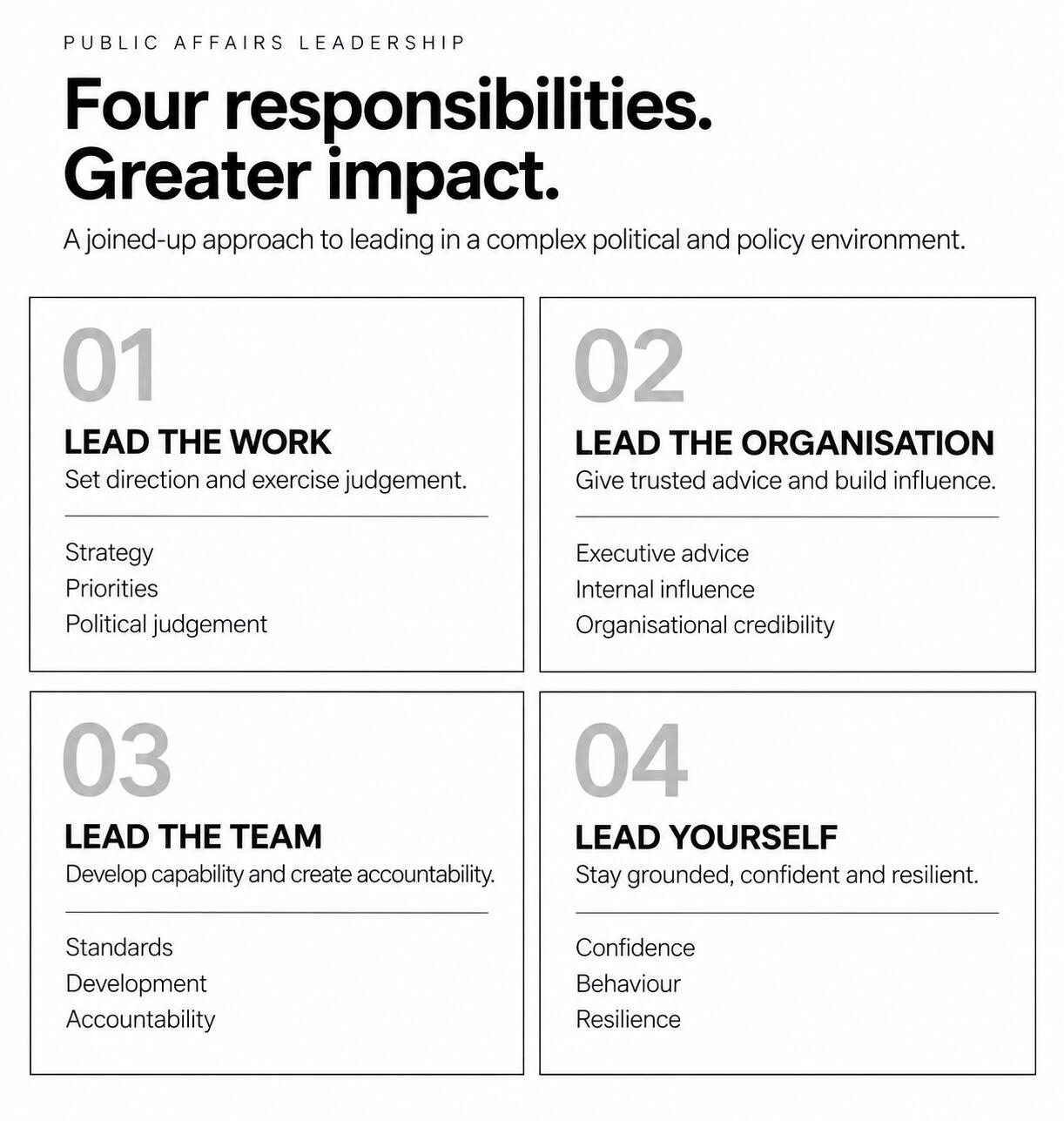
9. Integrating the four leadership responsibilities (15.15 to 16.00)
We will bring the main themes of the programme together through four central responsibilities:1. Leading the work: strategy, priorities and political judgement.
2. Leading the organisation: executive advice and internal influence.
3. Leading the team: standards, development and accountability.
4. Leading yourself: confidence, behaviour and resilience.Participants will assess their strengths, areas of inconsistency and most important development priorities.You will leave with a coherent framework for reviewing and continuing to develop your leadership.
10. Personal 90-day leadership plan (16.00 to 17.00)
Each participant will develop a focused plan covering:• One strategic leadership priority.
• One improvement to executive or internal influence.
• One team leadership priority.
• One personal leadership behaviour to strengthen.
• Actions, support and measures of progress.You will leave with practical commitments that can be applied immediately and reviewed over the following 90 days.
Other details
• Delivery: Face-to-face or online through Zoom, Google Meet or Microsoft Teams
• Duration: Two days, normally from 9.00 to 17.00.
• Scheduling: The programme can be delivered on two consecutive days or separated across several weeks.
• Participants: Up to three participants.
• Language: English.
• Tailoring: The programme will be adapted to participants’ roles, experience, organisational context and leadership priorities.
• Pre-programme preparation: A discovery call and participant questionnaire.
• Follow-up support: Additional coaching, mentoring or advisory support can be agreed following the programme.
Investment
Corporate organisations• 1 participant: £2,495
• 2 participants: £3,295
• Up to 3 participants: £3,995Early Stage Business and Small Charity RateA reduced rate is available for eligible early stage businesses and small charities with more limited leadership development budgets.• 1 participant: £1,695
• 2 participants: £2,295
• Up to 3 participants: £2,795Prices include:• Discovery call.
• Pre-programme preparation and tailoring.
• Two days of facilitated training.
• Programme materials.
• Personal leadership action planning.
• Post-programme resources.Travel and accommodation outside London are charged separately at cost.
Some more about me
I have worked for 25 years in public affairs, government relations, political strategy and policy influencing across the energy, automotive, creative industries and local government sectors.I have worked with FTSE-listed companies, Parliament, regulators, public bodies, trade associations, think tanks, consultancies and agencies.Organisations include:VPI | National Grid | BVRLA | Design Council | UK Power Networks | National Audit Office | Ofcom | Arts Council England | IPSA | Audit Commission | IPPR | Policy Network | UK Parliament | FleishmanHillard | Field Consulting | Greenhouse Communications | GK Strategy | Public Affairs Experts | Community Housing CymruMy experience includes:• Advising chief executives and senior leaders on political engagement.
• Designing public affairs strategies and campaigns.
• Translating political developments into strategic advice.
• Leading and developing public affairs teams.
• Supporting executive and board decision-making.
• Training, coaching and facilitating public affairs professionals and senior leaders.
Want to explore how I can help?
The first step is a discovery call.We will discuss:• The participants and their leadership responsibilities.
• Their current challenges and development priorities.
• What you want participants to gain from the programme.
• The organisational and political context.
• How the programme should be tailored.
• Whether I am the right person to support your participants.The purpose of the conversation is to understand what you need and establish whether the Public Affairs Leadership Programme is the right fit.